Briefing
How Many Wars Are Going On Right Now? The 2026 Count
Every published count of the world's wars side by side, from the research count that found more armed conflicts in 2025 than in any year since 1946 to legal counts past 130: what each one measures, and the wars behind the numbers.
The answer · verified 18 Nov 2026
13 wars in 2026 so far
13 of the 65 armed conflicts fought in 2026 have each killed at least 1,000 people this year, the threshold researchers use for a war. 11 were still being fought on 18 Nov 2026; 2 are under a ceasefire (Israel vs Hezbollah; Israel vs Hamas and allied groups).
Counted by Blackwing from the Uppsala Conflict Data Program's provisional data, 1 Jan 2026 to 30 Sep 2026: an armed conflict involves a state and kills at least 25 people in a year, and 140,009 people were killed in organised violence in those months. Legal counts, which apply different tests, run past 130; every published count is compared below.
| War | Killed in 2026 | Now |
|---|---|---|
| Russia vs Ukraine | 64,439 | Active |
| Yemen: Houthis vs the recognised government | 4,808 | Active |
| Israel vs Hezbollah | 4,593 | Ceasefire |
| Iran vs Israel and the United States | 3,859 | Active |
| Sudan: army vs the RSF-led alliance | 3,280 | Active |
| Somalia: government vs al-Shabaab | 2,915 | Active |
| Ethiopia: government vs Fano | 2,116 | Active |
| Pakistan: government vs the Pakistani Taliban | 2,075 | Active |
| Burkina Faso: government vs JNIM | 1,781 | Active |
| Nigeria: government vs Islamic State | 1,668 | Active |
| North-west Nigeria: government vs armed bands | 1,615 | Active |
| Pakistan: government vs Baloch insurgents | 1,365 | Active |
| Israel vs Hamas and allied groups | 1,155 | Ceasefire |
Killed: UCDP's best estimates for Jan to Sep 2026, provisional and likely to rise as coding catches up. Now: the war's status in its Blackwing record, re-verified against current reporting; each war links to that record, with its full death toll and every source, its latest developments, and its timeline on the globe.
In 2025 the world recorded 65 state-based armed conflicts, more than in any year since 1946. That is the count of the Uppsala Conflict Data Program (UCDP) at Uppsala University, whose record of armed conflict runs back to 1946, published on 9 June 2026 - Journal of Peace Research. Thirteen of those conflicts were wars by UCDP's definition, and eight were fought directly between states, the highest number since the record begins. Roughly 245,000 people died in organized violence that year, which makes 2025 the third deadliest year since the end of the Cold War - PRIO.
So the question has an answer. The trouble is that it has several. Ask how many wars are being fought and, depending on who you ask, you will hear 13, or 27, or 50, or 65, or 112, or more than 130. Every one of those numbers is real and sourced. None of them is a mistake. They are answers to different questions: what counts as a war, how many people have to die before a fight is counted, whether a cartel or a gang can be a party, and whether you are counting conflicts, countries, or legal situations. A reader who takes one of them as "the number" will be confidently wrong in a way that is hard to notice, because the figure looks precise and comes from a respectable source.
This guide sets every published count side by side and says exactly what each one measures. It explains the three rulebooks that produce them, reads the newest data on why the number of conflicts has doubled since 2010, gives a first count for 2026 from UCDP's provisional releases, and then walks through each war being fought right now, with its documented toll and its record on Blackwing, where the same wars play on one globe. It ends with the violence that war counts leave out and a short framework for choosing the number that fits the question you are actually asking.
Contents
- Why the answer runs from 13 to more than 130
- What counts as a war: three rulebooks
- 2025: the most armed conflicts since 1946
- Why the number doubled after 2010
- How deadly: 245,000 dead, and where they fell
- 2026 so far: the provisional count
- The wars being fought right now
- The violence the war counts leave out
- How to read any war count yourself
- Conclusion: which number answers which question
Every count at a glance
The table below lists every serious count of the world's armed conflicts that is publicly cited, with its latest figure in the "What it counts" column. Because the counts answer different questions, they are not ranked by how large or small their number is. They are scored for one practical job: how well each serves a reader who needs a citable, defensible number. Each score runs from 0 (absent) to 10 (best in class), and the final column is the weighted average.
| # | Count | What it counts | Definition (30%) | Transparency (25%) | Timeliness (20%) | Breadth (25%) | Final |
|---|---|---|---|---|---|---|---|
| 1 | UCDP (Uppsala) | 65 state-based conflicts, 13 wars in 2025 | 10: 25 and 1,000 battle-death thresholds, published word for word | 10: every conflict-year and incident free to download, CC BY 4.0 | 7: final data each June, provisional data monthly | 8: counts non-state and one-sided violence too, but separately | 8.9 |
| 2 | Geneva Academy War Watch | 112 armed conflicts under the law of war | 9: legal tests (any force between states; intense, organized fighting inside them) | 9: each case published with its legal reasoning | 8: updated as situations change, since November 2025 | 8: includes occupations and cartel wars that meet the test | 8.6 |
| 3 | ACLED Conflict Index | 50 countries at extreme, high or turbulent levels | 8: four indicators published; levels are relative ranks | 8: full country rankings in a public spreadsheet | 7: annual index, with mid-year editions in past years | 10: all political violence (Mexico, Brazil, Ecuador rank "extreme") | 8.3 |
| 4 | Wikipedia's ongoing-conflicts list | 8 "major wars" with 10,000+ deaths this year or last | 6: four death bands stated; scopes differ row by row | 7: every row footnoted to its sources | 9: open to edits at any moment | 8: includes cartel wars and rebel groups | 7.4 |
| 5 | Blackwing | 16 sourced war records on one globe | 7: inclusion rule stated in this guide; figures as ranges | 10: every figure linked to its source, data open under CC BY 4.0 | 9: each record dated to the day it was last re-verified | 3: the deadliest conflicts only, not a census | 7.2 |
| 6 | ICRC | More than 130 armed conflicts in 2025 | 7: legal tests set out in its 2024 opinion paper | 4: its assessments are generally public, but no list backs its total | 5: repeated in annual reports and statements | 9: every situation meeting the legal test | 6.4 |
| 7 | Global Peace Index 2026 | 61 state-based conflicts | 8: inherits UCDP's published definition | 5: cites the total; the conflict list sits with UCDP | 4: annual; its 2026 count matches UCDP's 2024 figure | 6: state-based conflicts only, inside a wider peace index | 6.0 |
| 8 | IISS Armed Conflict Survey | Nearly 240,000 conflict deaths, July 2024 to June 2025 | - | 4: a paid annual book; its opening chapter is free | 5: annual, on a July-to-June year | 7: includes organized crime, Haiti's gangs among it | 5.4 |
| 9 | CFR Global Conflict Tracker | 27 conflicts, rated by impact on US interests | 3: no inclusion threshold stated on the tracker | 7: each conflict has a public profile | 6: status labels, no stated update cadence | 4: 27 conflicts selected for US relevance | 4.9 |
The weights follow what matters when a number goes into an article, a report or a briefing. Definition (30%), whether the rules of the count are published, carries the most weight because a count whose rules you cannot read cannot be checked against anything. Transparency (25%) asks whether you can see the individual conflicts behind the total, which is what lets you test the total. Timeliness (20%) is how current the figure is, and breadth (25%) is whether the count can see violence outside classic state-versus-rebel war, such as cartel wars and attacks on civilians. The IISS score excludes the definition criterion, which this guide could not verify, and averages the other three. Two cautions belong beside the table. A high score does not make a count "right": the right count depends on your question, which the conclusion addresses. And Blackwing is scored by the same standard as everyone else, which is why it sits fifth: its records are fully sourced and current, but sixteen records are a selection of the deadliest wars, not a census of all of them.
1. Why the answer runs from 13 to more than 130
The single most useful thing to understand about any count of wars is that it is not an observation. Nobody can look at the world and see "65 conflicts" the way a thermometer sees a temperature. A count of wars is the output of a procedure, and every such procedure has to make the same four choices. It has to choose a unit (a conflict, a dyad of two warring parties, a country, a legal situation). It has to choose a threshold (how much violence before something counts). It has to choose a scope (whether only states and rebels count, or cartels, gangs and militias too). And it has to choose a window (a calendar year, a rolling twelve months, or "ongoing right now"). Change any one of those choices and the number moves, sometimes by a factor of ten.
This is not a weakness of the counters. It is the nature of the thing being counted. Armed violence does not arrive pre-sorted into discrete "wars". The fighting in eastern Congo involves more than a hundred armed groups, an international dispute between two states and a regional peace process, all in the same provinces. Myanmar's civil war is fought by a military government against resistance forces and ethnic armies that ACLED counts at more than 1,200 distinct armed groups in a single year - ACLED. Whether that is one war, five conflicts or a thousand fights is a decision, not a discovery. The honest response is not to pick a number and defend it. It is to know which question each number answers.
The chart below puts the main published counts on one axis. Read it as seven answers to seven different questions, not as seven estimates of one quantity.
Source: UCDP 2026; CFR; ACLED Conflict Index 2025; Geneva Academy War Watch; ICRC Annual Report 2025
The numbers
| Source | Count |
|---|---|
| UCDP wars | 13 |
| CFR tracker | 27 |
| ACLED countries | 50 |
| UCDP conflicts | 65 |
| UCDP non-state | 75 |
| Geneva Academy | 112 |
| ICRC (130+) | 130 |
The smallest number, 13, is UCDP's count of wars in 2025: conflicts in which at least 1,000 people died in battle in that calendar year. The 65 beside it is the same organization's count of all state-based armed conflicts, which only need 25 battle deaths a year to qualify. The 75 is UCDP's count of a different category altogether, fights between two armed groups with no government involved, which it publishes separately and never adds to the 65. The 112 is the Geneva Academy's count of situations that legally qualify as armed conflicts under international humanitarian law - Geneva Academy. The ICRC's figure of more than 130 is a legal count of the same kind - ICRC. The 50 is not a count of conflicts at all but of countries, the ones ACLED's index places at extreme, high or turbulent levels of political violence. And the 27 is the number of conflicts the Council on Foreign Relations has chosen to track for their relevance to US interests - CFR.
Why does this matter for anyone who is not a statistician? Because the numbers travel without their definitions. A headline that says "the world has 130 wars" and another that says "the world has 13 wars" can both be accurate, and a reader comparing them will conclude that one of them is lying. Worse, the same source can be quoted against itself across years when its definition or its data changes, which is exactly what happened in June 2026, when two respected reports published on the same day gave 61 and 65 for the number of state-based conflicts (section 3 explains why both were right). The practical rule that follows is simple and worth applying every time: before you repeat a war count, find its unit, threshold, scope and window. If you cannot find all four, you do not yet know what the number means.
The rest of this guide applies that rule. The next section opens the three rulebooks that generate almost every count you will see, because once you know how each one works, the spread in the chart above stops looking like disagreement and starts looking like what it is: a set of instruments pointed at the same violence from different angles.
2. What counts as a war: three rulebooks
Almost every war count in circulation comes from one of three traditions, and each was built for a different purpose. The first is the data tradition, which counts deaths in order to measure conflict for research. Its standard-bearer is UCDP at Uppsala University, whose definitions underpin the PRIO reports, the Global Peace Index and most academic work. The second is the legal tradition, which classifies situations in order to know which body of law applies. The ICRC and the Geneva Academy's War Watch work this way. The third is the event tradition, which records individual violent events, including protests, riots and gang violence, and builds indices from them. ACLED is its main source. Each tradition is internally rigorous. They disagree because they are measuring different things for different reasons.
Understanding the three is worth the effort because each has a characteristic blind spot, and the blind spots are where misleading claims live. The data tradition is precise about deaths but needs a death to be reported and attributable before it counts. The legal tradition captures situations the data tradition misses, such as a military occupation with little fighting, but its full lists are not always public. The event tradition sees violence that neither of the others counts as war, such as cartel and gang violence, but ranks countries rather than counting wars. The diagram below shows how the same violence flows into three different numbers.
The data tradition: UCDP's thresholds
UCDP defines a state-based armed conflict as "a contested incompatibility that concerns government and/or territory where the use of armed force between two parties, of which at least one is the government of a state, results in at least 25 battle-related deaths in one calendar year" - UCDP definitions. A conflict becomes a war when it reaches at least 1,000 battle-related deaths in a calendar year, and anything between 25 and 999 is a minor conflict. Two further categories sit beside these and are never folded into them: non-state conflict, fighting between two organized armed groups with no government involved, and one-sided violence, the deliberate killing of civilians by a government or an organized group. Each has its own 25-death threshold.
Three features of this rulebook explain a great deal of public confusion. First, the unit is the incompatibility, the thing being fought over (control of a government, or of a territory), not the armed group. Several rebel groups fighting over the same government join one conflict, while a group with a different aim creates a new one. Second, the clock is the calendar year, so a conflict can be a war in one year and a minor conflict in the next without anything fundamental changing. Third, UCDP defines a government as "the party controlling the capital of the state". That rule produces results that surprise readers: because the Houthi authorities hold Sanaa, UCDP's data lists them as the Government of Yemen, and records the internationally recognized government's forces as the opposing side. It is not a political endorsement. It is a rule applied consistently, and knowing it explains why US, British and Israeli strikes on the Houthis appear in UCDP's data as conflicts between states.
The legal tradition: what humanitarian law calls an armed conflict
International humanitarian law applies to armed conflict, which it treats as a matter of fact, "dependent on neither a declaration nor recognition of the existence of 'war' by its parties". The Geneva Conventions do not even define the term, and the ICRC says that is no oversight: "the omission plays an important role in depoliticizing the application of the Conventions", because a government can always claim it is conducting a police action rather than a war - ICRC. Instead the law applies two tests. Between states there is no intensity threshold: as the ICRC's legal team put it in 2024, "even minor skirmishes between states may trigger an IAC", an international armed conflict - ICRC Law and Policy. Inside a state, a non-international armed conflict requires "a minimum level of intensity and a minimum degree of organization of the parties", the test courts have applied since the Tadić case at the Yugoslavia tribunal.
That is why the legal counts run so much higher than UCDP's. A border exchange of fire between two armies that kills nobody is an international armed conflict in law and nothing at all in UCDP's data. A military occupation with little fighting is a legal situation with its own obligations and no battle deaths to count. And a cartel can be a party to an armed conflict if it is organized enough and the violence intense enough. The Geneva Academy's War Watch, which in November 2025 merged the Academy's long-running RULAC project with its IHL in Focus reporting, currently covers 112 armed conflicts: 34 international armed conflicts, including 9 situations of military occupation, and 78 non-international ones - Geneva Academy. Each classification is published with its legal reasoning on War Watch, which is what makes it checkable.
The event tradition: ACLED's index
ACLED does not count wars. It records individual events of political violence and demonstration in every country, and its annual Conflict Index ranks countries on four indicators: deadliness (how many people are killed), danger (how much violence targets civilians), diffusion (how much of the populated territory sees high levels of violence) and fragmentation (how many armed groups are active) - ACLED. Its December 2025 edition covered 1 December 2024 to 28 November 2025, recorded 204,605 conflict events and "conservatively" more than 240,000 deaths, and placed 50 countries in its extreme, high or turbulent categories, ten of them extreme.
ACLED estimated that conflict exposed 17 percent of the world's population, one person in six - ACLED. Because the index weighs danger to civilians, spread and fragmentation alongside deaths, it produces rankings that look strange through a war lens. Ukraine had the most reported fatalities of any country in the index, 77,912, yet ranked only joint eleventh, because its war is fought by very few armed groups and ranks 51st on fragmentation. Mexico, Brazil and Ecuador, none of which had a state-based armed conflict in UCDP's 2025 data, all sit in the "extreme" top ten because of cartel and gang violence. Neither ranking is wrong. ACLED measures how dangerous and how fractured a country's political violence is, which is a different question from how many wars it hosts.
The practical lesson from the three rulebooks is to match the rulebook to the purpose. If you are measuring how many wars the world is fighting in a strict sense, UCDP's thresholds are the standard and their data can be checked conflict by conflict. If your question is which legal obligations apply, and to whom, the legal counts are the relevant ones. And if you want to know where ordinary people face violence, ACLED's index is built for that. Mixing them, for instance quoting the ICRC's 130 as a number of "wars" or ACLED's 50 as a number of "conflicts", is where most of the misleading numbers in circulation come from. Weighing rival definitions like these is the craft of political scientists and historians, whom AI labs pay by the hour to judge a model's arguments and sources, and the humanities and social science jobs on AITraining.jobs, a board that shares an owner with Blackwing, list that work.
3. 2025: the most armed conflicts since 1946
UCDP's 2026 release, published in the Journal of Peace Research by Shawn Davies, Therése Pettersson and Magnus Öberg, is the program's own account of the year, and its central finding is stark: "the number of state-based conflicts reached a record high of 65", with interstate conflicts "doubling for the second consecutive year to eight in 2025" - Journal of Peace Research. The Peace Research Institute Oslo's companion report, Conflict Trends: A Global Overview, 1946-2025, located those 65 conflicts in 35 countries, more than in 2024 - PRIO. Both reports are built on the same data, UCDP's version 26.1, which anyone can download and check - UCDP.
The record is not a statistical artifact of a single bad year. Reading the dataset directly, the count has risen in steps since the early 2010s, with dips along the way, from 31 conflicts in 2010 to 52 in 2018, 57 in 2019 and 2020, 59 in 2023 and 2024, and 65 in 2025. The number of wars has risen even more sharply in the last four years, from five in 2021 to thirteen in 2025, matching 2014 as the most in any year since 1992. The chart below shows the last eight years from UCDP's data.
Source: UCDP/PRIO Armed Conflict Dataset v26.1
The numbers
| Year | State-based conflicts | Wars (1,000+ deaths) |
|---|---|---|
| 2018 | 52 | 6 |
| 2019 | 57 | 7 |
| 2020 | 57 | 8 |
| 2021 | 54 | 5 |
| 2022 | 56 | 8 |
| 2023 | 59 | 9 |
| 2024 | 59 | 11 |
| 2025 | 65 | 13 |
The thirteen wars of 2025, in UCDP's coding, were fought in Russia and Ukraine, between Iran and Israel (the twelve days of June), in Israel and the Palestinian territories, in Sudan, the Democratic Republic of the Congo, Ethiopia (against the Fano militias in Amhara), Somalia, Burkina Faso, Mali, Nigeria (against the Islamic State's West Africa affiliate), Pakistan (against the Pakistani Taliban and allied groups), Myanmar and Haiti. Several barely crossed the line: Myanmar's war recorded about 1,350 battle deaths, the Iran-Israel war about 1,220, Haiti's about 1,210 and Mali's about 1,090. That is a reminder of how much a hard threshold does. A conflict at 990 deaths and one at 1,010 are the same kind of violence, and only one of them is a "war".
The longer view makes the shape of the rise clearer, and UCDP's own chart of conflicts by region since 1946 is the best single picture of it.
State-based armed conflict by region, 1946-2025
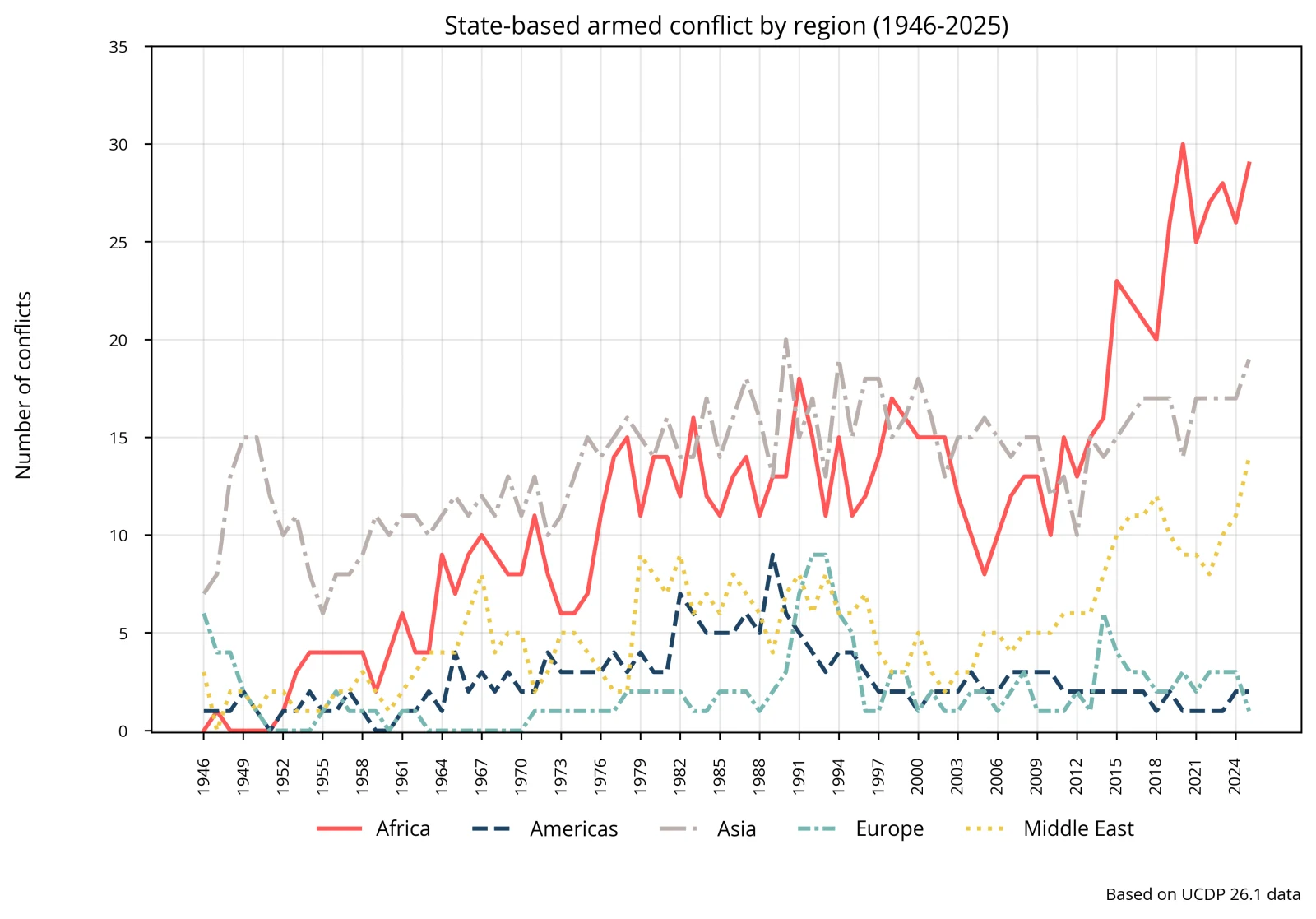
Two lines in that chart carry most of the story. Africa, which had between 8 and 15 conflicts a year through the 2000s, recorded 29 in 2025, close to its all-time peak of 30 in 2020. And the Middle East reached 14, its highest count in the entire series, driven by the regional war around Israel, Iran, Yemen and Lebanon. Asia climbed back to about 19, led by Myanmar, Pakistan and India, while Europe and the Americas stayed low in the number of conflicts even as Europe hosted the deadliest one by far. The concentration matters: PRIO's report noted that Myanmar and Israel each saw five distinct conflicts in 2025 - PRIO.
The rise of interstate conflict is the most consequential part of the record, because wars between states are the kind the post-1945 system was built to prevent. All eight of 2025's interstate conflicts are visible in UCDP's dataset: Russia and Ukraine; Iran and Israel; India and Pakistan, whose four days of fighting began with India's missile strikes on 7 May and ended in a ceasefire on 10 May - War Watch; Thailand and Cambodia, whose border fighting began on 24 July; Afghanistan and Pakistan; Israel and Syria; Israel and the Houthi authorities in Yemen; and the United States and United Kingdom against the Houthis. The last two count as interstate only because of UCDP's capital rule described above, which shows again how much a definition decides.
Several of these were short, and short wars between states are easy to forget. The Thailand-Cambodia fighting killed at least 48 people and displaced more than 300,000 civilians in July, flared again in early December and ended with a ceasefire agreement on 27 December, according to the Geneva Academy's classification - War Watch. The India-Pakistan war lasted four days. Neither would appear in a list of "ongoing wars" today, yet both count fully in 2025's record, which is a reminder that a calendar-year count measures how much war a year contained, not how much is being fought on any given morning.
PRIO presented these findings at a public launch in June 2026. The recording below is the researchers' own presentation of the report, including their discussion of why interstate conflicts are increasing after decades dominated by civil wars, and why violence is becoming concentrated in a smaller number of countries.
Global conflict data release: A dangerous resurgence of war
There is one wrinkle worth knowing, because it causes real confusion. On the same day UCDP's paper reported 65 conflicts, the Global Peace Index 2026 reported "the number of active, state-based conflicts reaching 61", the highest since the Second World War - Vision of Humanity. Both statements are accurate. Sixty-one is the figure UCDP published for 2024 a year earlier - Uppsala University, and the index works from that earlier release. Since then UCDP has revised its 2024 count to 59 as better information came in, and published 65 for 2025. The practical lesson: a conflict count is a vintage, not a constant. When two credible figures disagree by a few conflicts, check which year they describe and which release of the data they come from before concluding that anyone is wrong.
4. Why the number doubled after 2010
The obvious explanation for a doubling in armed conflicts is that the world became more violent. That is partly true, but it is not the main mechanism, and the data lets us see the actual mechanism precisely. Because UCDP counts incompatibilities, a new conflict appears whenever an armed group with a new aim, or a new pair of states, starts fighting at the threshold. So the question to ask is not "is there more violence?" but "where did the new incompatibilities come from?" Sorting UCDP's 2010 and 2025 conflict lists by the kind of party on the opposing side answers it.
Source: UCDP/PRIO Armed Conflict Dataset v26.1
The numbers
| Kind | 2010 | 2025 |
|---|---|---|
| Other civil wars | 25 | 38 |
| Islamic State | 1 | 12 |
| Al-Qaeda affiliates | 5 | 7 |
| Between states | 0 | 8 |
Of the 34 additional conflicts between 2010 and 2025, eleven are conflicts with Islamic State affiliates, which went from one in 2010 to fourteen in 2015 and twelve in 2025, and eight are conflicts between states, which went from none to eight. Groups affiliated with al-Qaeda, such as JNIM in the Sahel and al-Shabaab in Somalia and Kenya, add two more. Everything else, the classic civil wars over a government or a territory, accounts for thirteen. In other words, 21 of the 34 extra conflicts, about six in ten, come from two specific mechanisms, the franchising of jihadist insurgency and the return of war between states, rather than from a general rise in civil war.
The Islamic State effect is a direct consequence of how conflicts are counted. When an Islamic State affiliate fights a government, its stated aim, a territory it calls the Islamic State, is a different incompatibility from any local rebellion, so each affiliate creates a separate conflict in each country where it reaches 25 battle deaths. In 2025 that meant twelve conflicts in twelve countries: Afghanistan, Burkina Faso, Cameroon, the Democratic Republic of the Congo, Iraq, Mali, Mozambique, Niger, Nigeria, Pakistan, Somalia and Syria. A single franchise, operating as a loose network of local insurgencies, contributes more "conflicts" to the global count than the Americas and Europe put together. That does not make those conflicts less real, since each kills people in its own place. But it does mean that the doubling partly measures the franchising of insurgency rather than the spread of war in the usual sense.
The interstate effect is different in kind and, for the international system, more serious. Eight interstate conflicts in one year is unprecedented in UCDP's record, and they came from three distinct sources: a great-power war in Europe, a regional war radiating from Israel and Iran that drew in Yemen, Syria, the United States and the United Kingdom, and short, sharp border wars in South Asia (India and Pakistan, both nuclear-armed, and Afghanistan and Pakistan) and in South-East Asia between Thailand and Cambodia. The common thread is that states are again using force against each other directly, rather than only through proxies. PRIO's launch was framed around exactly this question, why interstate conflicts are increasing again after decades dominated by civil wars.
Pressure-testing the "more war" reading also turns up a counter-trend. More conflicts do not mean proportionally more countries at war. PRIO counts 35 countries with state-based conflict in 2025, against 25 in 2010 by the same dataset, so the countries hosting conflict rose by two-fifths while the conflicts more than doubled. Conflicts are clustering. Myanmar and Israel hosted five conflicts each, and Pakistan, Nigeria and Mali several. Deaths are even more concentrated. In UCDP's 2025 data, Russia-Ukraine alone accounted for 62 percent of all battle-related deaths in state-based conflicts, and the three deadliest conflicts together (Ukraine, Gaza and Sudan) for 79 percent. Meanwhile 25 of the 65 conflicts recorded fewer than 100 battle deaths in the year. The world has more conflicts, many of them small, and a few that are enormous.
The practical upshot for anyone citing the trend is to keep two claims separate. "There are more armed conflicts than at any time since 1946" is true and well documented. "The world is more violent than at any time since 1946" is a different claim, and it is not what the conflict count shows: total deaths in organized violence were higher in 2022 and in 1994, as the next section shows, and the conflict count rises partly because of how insurgencies are now organized. Both facts are alarming. They are not the same fact.
5. How deadly: 245,000 dead, and where they fell
Counting conflicts tells you how widespread organized violence is. Counting deaths tells you how severe it is, and the two can move in opposite directions. UCDP's 2026 paper put total deaths in organized violence in 2025 at about 244,600, "up from approximately 187,000 in 2024" - Journal of Peace Research. Of those, about 153,600 died in state-based conflicts, 14,500 in non-state conflicts (the lowest since 2013) and about 76,500 in one-sided violence against civilians, which UCDP called "the highest number of fatalities from one-sided violence since the Rwandan genocide in 1994". The IISS, counting on a July-to-June year across its own set of conflicts, recorded "nearly 240,000 fatalities related to violent events" between July 2024 and June 2025, an increase of about 23 percent - IISS.
The chart below shows how 2025 compares with the years before it, from UCDP's three datasets for each type of violence.
Source: UCDP battle-related deaths, non-state and one-sided violence datasets v26.1
The numbers
| Year | All organized violence | State-based conflict | One-sided violence |
|---|---|---|---|
| 2018 | 88,225 | 55,166 | 5,187 |
| 2019 | 77,244 | 52,676 | 5,536 |
| 2020 | 102,763 | 73,139 | 8,948 |
| 2021 | 233,754 | 199,816 | 12,030 |
| 2022 | 316,895 | 284,981 | 12,172 |
| 2023 | 169,400 | 138,917 | 11,341 |
| 2024 | 187,023 | 155,038 | 14,260 |
| 2025 | 244,579 | 153,643 | 76,453 |
Two years stand out. 2022, the first year of Russia's full-scale invasion of Ukraine, remains the deadliest of the recent period, with about 317,000 deaths, most of them in state-based conflict. And 2021, the year of the Tigray war, saw deaths more than double from 2020: UCDP's event data attributes about 130,000 deaths that year to Ethiopia alone. The shape of 2025 is different from both: deaths in battle held roughly level with 2024, while killings of civilians jumped fivefold. Almost all of that jump has one source. UCDP attributes about 62,000 deaths in 2025 to one-sided violence by the RSF-led Sudan Founding Alliance, with a low estimate of about 8,300 and a high estimate of about 77,000 - UCDP. The width of that range, nearly tenfold, is itself information: it reflects how little independent access there was to Darfur when the RSF took El Fasher in October 2025, and PRIO described the massacre there as having killed "tens of thousands of civilians" - PRIO.
UCDP's own chart of fatalities by type of violence since 1989 puts 2025 in its full historical context, including the Rwandan genocide, which dwarfs every other year in the series.
Fatalities in organized violence by type of violence, 1989-2025
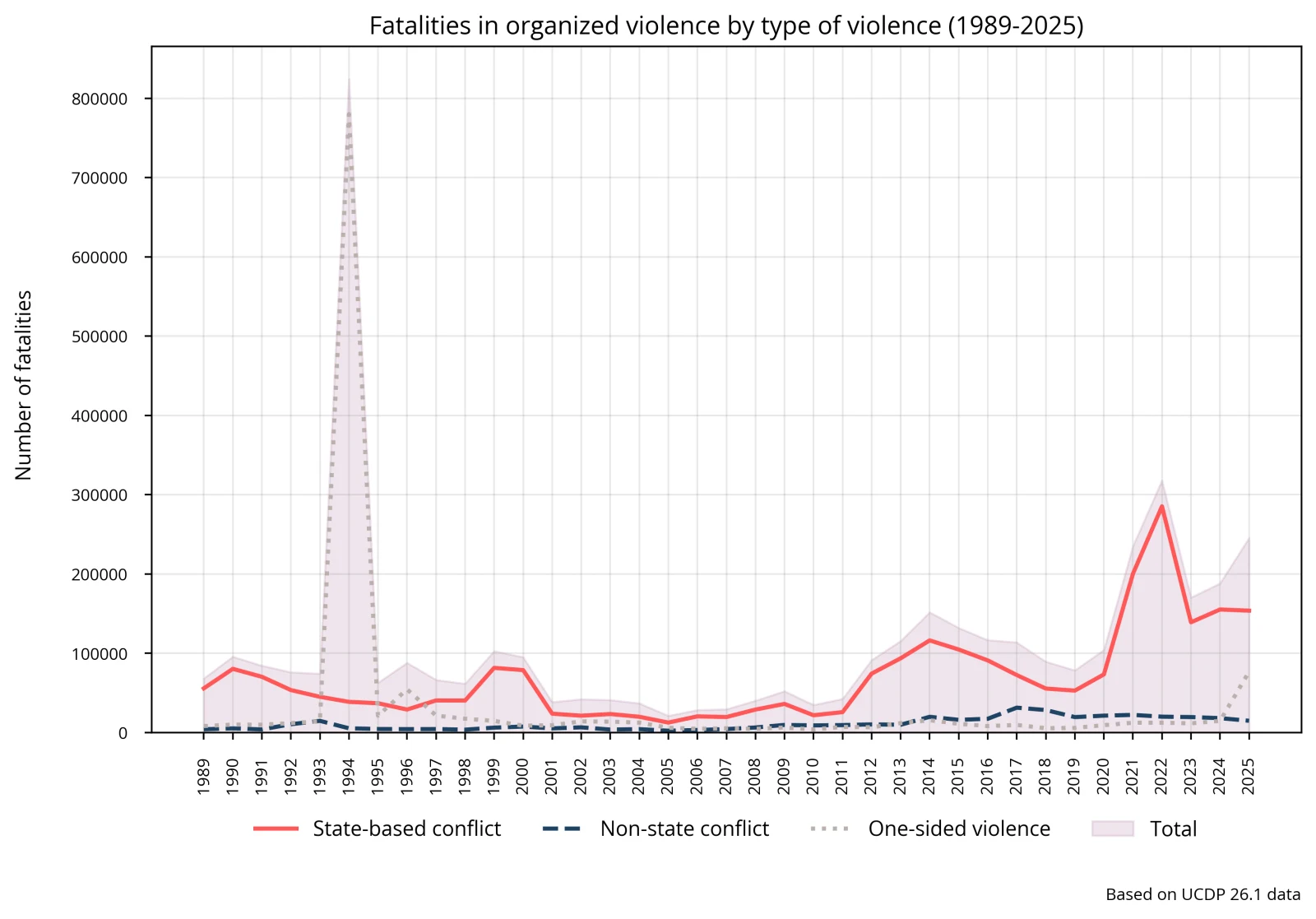
Where did the battle deaths of 2025 fall? The answer is extremely uneven. The chart below shows the eight deadliest state-based conflicts of the year in UCDP's data, which together account for about 90 percent of all battle-related deaths.
Source: UCDP Battle-Related Deaths Dataset v26.1
The numbers
| Conflict | Battle-related deaths |
|---|---|
| Russia-Ukraine | 94,741 |
| Israel-Hamas | 14,434 |
| Sudan | 12,269 |
| DR Congo | 4,428 |
| Ethiopia (Fano) | 3,835 |
| Somalia | 2,989 |
| Burkina Faso | 2,939 |
| Pakistan (TTP) | 2,511 |
Every one of these numbers is a floor, and that is the most important caveat in this section. UCDP counts direct deaths that it can tie to a sourced incident. It does not count people who die of hunger, disease or collapsed health care because of a war, and in Sudan, Yemen, Gaza and eastern Congo those indirect deaths are believed to be large. The IISS makes the same point about its own figure, noting that deaths related to malnutrition and starvation are not included. It also cannot count violence that never reaches a report, which matters most where access is worst. A war fought behind an internet blackout or in a remote borderland will be undercounted relative to one fought in front of cameras. This is why Blackwing shows every toll as a documented range with its basis spelled out, and why our briefing on how many died in the Twelve-Day War spends most of its length on what a count can and cannot see.
For a reader, the way to apply this is to ask of any death toll whether it is direct or total, documented or modelled, and floor or estimate. UCDP's numbers are direct, documented floors. Excess-mortality studies are modelled estimates of total deaths. Official counts by a warring party are claims by an interested witness. All three have their place, and none of them can be compared with the others without saying which is which.
6. 2026 so far: the provisional count
UCDP's final figures for 2026 will not exist until the middle of 2027, because each annual release is checked and revised before publication. But the program also publishes provisional releases: a monthly release coding each month's incidents within weeks, and each quarter a reviewed release covering the year so far. Anyone can read them - UCDP. Blackwing's globe draws its conflict timelines from exactly these files, and they allow a first, honest answer to the question this guide's title asks. It comes with caveats, so they come first. The data is provisional and will be revised, usually upward, as coding catches up with reporting. Conflicts that UCDP has not yet formally registered carry placeholder identifiers. And applying a 25-death threshold to nine months of data is our tally, not UCDP's official method, which works on whole calendar years.
With those caveats stated, the count is striking. In UCDP's reviewed provisional release for January to September 2026, by our tally, 65 state-based conflicts had already crossed the 25-death threshold, equal to 2025's full-year total, itself the most since 1946, and 13 had passed 1,000 deaths, matching 2025's total of wars with three months still to run. The release records about 140,000 deaths in organized violence over the nine months: roughly 104,000 in state-based conflict, 27,000 in one-sided violence against civilians and 8,500 in fighting between non-state groups. The chart below shows the eight deadliest conflicts of the year so far.
Correction, 6 October 2026. The first version of this section gave 65 conflicts and about 126,000 deaths for January to August 2026. Our tally had kept nearly 500 events that UCDP's review of January to June had removed, most of them preliminary codings in Colombia and Nigeria that UCDP had flagged for checking. Since then this section, like every record on the site, reads UCDP's reviewed release in place of the monthly releases it covers.
Source: UCDP Candidate Events Dataset v26.01.26.09
The numbers
| Conflict | Deaths, Jan-Sep 2026 |
|---|---|
| Russia-Ukraine | 64,439 |
| Yemen | 4,808 |
| Israel-Hezbollah | 4,593 |
| Iran vs US, Israel | 3,859 |
| Sudan | 3,280 |
| Somalia | 2,915 |
| Ethiopia (Fano) | 2,116 |
| Pakistan (TTP) | 2,075 |
Three features of 2026 stand out from the provisional data. The first is that Russia's war in Ukraine remains in a category of its own, with more than thirteen times the coded deaths of any other conflict. The second is the arrival of new interstate wars. The war that began on 28 February with US and Israeli strikes on Iran is a new conflict in UCDP's coding. So is the US operation in Venezuela on 3 January, when US forces struck targets around Caracas and captured President Nicolás Maduro - CNN. UCDP's reviewed provisional data codes about 80 deaths in that operation as fighting between the two governments, and the Geneva Academy classified it as an international armed conflict that ended the day after Maduro's capture - War Watch. Fighting in Iraq between US and Israeli forces and Iraqi forces, which the provisional data codes under the Iraqi government, appears as a further new conflict.
The third feature is the return of old wars. Fighting between Yemen's Houthi authorities and the government's coalition resumed in July after four years of truce, and by September it was the second deadliest conflict of the year: UCDP codes about 4,400 of its 4,800 deaths this year to August and September alone, more than ten times its total for all of 2025. The Israel-Hezbollah war resumed in March and is the third deadliest. In Ethiopia, the Tigray People's Liberation Front returned to war with the federal government in August, a conflict that had been inactive in UCDP's data since 2022, the year of the Pretoria agreement. In Pakistan, the Balochistan insurgency passed 1,300 coded deaths by September, more than two and a half times its total for all of 2025, and Pakistan's border war with Afghanistan became open war in February. UCDP's provisional coding also records a new state-based conflict in north-western Nigeria, where the named opponents include the armed bands of Bello Turji, Dogo Gide and Ado Alero, with about 1,600 deaths by September.
Most of this was forecast. When the International Crisis Group published its 10 Conflicts to Watch in 2026 on the last day of 2025, its list read: Venezuela, Sudan, Ethiopia-Eritrea, Mali and Burkina Faso, Ukraine, Syria, Israel-Palestine, Israel and the United States versus Iran and the Houthis, Myanmar, and Afghanistan-Pakistan - Foreign Policy. By October, Venezuela had been struck, Iran and the Houthis were at war with Israel, the United States or Saudi Arabia, Eritrea had cut diplomatic ties with Ethiopia, and Pakistan's defence minister had called the fighting with Afghanistan open war. A watch list is not a count, but it shows something useful about both: the analysts who track these conflicts day to day knew where the threshold was likely to be crossed, which is why a count read with its sources tends to confirm rather than surprise.
How should a reader use a provisional count? Treat it as an early reading, and know what review does to it. UCDP has now reviewed the year twice. When its January-to-June release replaced the monthly files, it added about 630 events, removed nearly 500 and revised hundreds more, yet on balance raised the six months' coded deaths by about 1,500 and left the number of conflicts past the threshold unchanged. Its January-to-September release did the same to the months it read again: against the files it replaced, January to August gained about 1,300 events and lost about 330, about 1,500 more deaths on balance, and still 63 conflicts past the threshold. With three months still to code, more conflicts are likely to cross the threshold than to fall back under it, though several sit just above 25 deaths and a review can move them. But do not treat the death totals as final, and do not compare nine provisional months with a full, revised year. When UCDP publishes its 2026 figures, the right comparison will be with 2025's 65 conflicts and 13 wars, and on current evidence 2026 is on course to match or exceed both.
7. The wars being fought right now
This section walks through each war that Blackwing tracks, as of 18 November 2026. Together they cover every war-level conflict that UCDP coded in 2025 or in the first nine months of 2026, grouped by theatre, with Burkina Faso, Mali and Niger treated as one Sahel conflict system, plus Syria, which stays on the record because of its multiple active conflicts and foreign forces. Each entry gives the war's status, what changed in 2026, and its documented toll, and each links to its record, where every figure sits beside its source and the war plays on the globe.
Two reading rules apply throughout. Every death figure is labelled with who counted it and how, and none should be compared with another without that label: a health ministry's register, an independent monitor's documented count and UCDP's coded incidents are different instruments. And the tolls are floors, because they count direct deaths that someone could document. Where an entry gives a range, the low end is the documented minimum and the high end is the highest credible published count, never an estimate of our own.
Russia and Ukraine
Russia's full-scale invasion of Ukraine, launched on 24 February 2022, is by a wide margin the deadliest war in the world. In UCDP's data it accounted for about 94,700 battle-related deaths in 2025, 62 percent of all battle deaths in state-based conflict that year, and about 64,400 in the first nine months of 2026. Since February 2022 UCDP has documented between about 375,000 and 645,000 deaths in sourced incidents, in Russia as well as Ukraine, and even that is a floor: both governments treat military casualties as state secrets, so the true military toll is unknown and widely believed to be higher. Civilian deaths are better documented. The UN Human Rights Monitoring Mission had verified 17,605 civilians killed and 55,846 injured by 30 September 2026, including 328 killed in September alone, the most for any September of the full-scale invasion, and says plainly that the real figures are considerably higher - OHCHR.
Diplomacy in 2026 produced moments rather than a settlement. The first talks between Ukraine, Russia and the United States together since 2022 opened in Abu Dhabi on 23 January - CNN, and a three-day ceasefire on 9 to 11 May came with an exchange of 1,000 prisoners by each side - NPR. In September President Trump said both sides had agreed not to strike each other's energy facilities, but the Kremlin did not confirm it. By early October Russia was striking Kyiv's bridges over the Dnipro on consecutive days, with the Institute for the Study of War counting seven strikes on them between 1 and 4 October - ISW, while President Zelensky said the United States was proposing a technical-level meeting of the three countries by the end of October - The Kyiv Independent.
This war also shows why the counters disagree in instructive ways. ACLED's index records more fatalities in Ukraine than in any other country, yet ranks it only joint eleventh, because the war is fought between two state armies rather than among dozens of armed groups. In UCDP's data it is one conflict between two governments; in law it is an international armed conflict running alongside a military occupation. The full record, with every count and its basis, is on the Russia-Ukraine war page.
Iran, the United States and Israel
The newest major war began on 28 February 2026, when US and Israeli forces struck Iran in operations they named Epic Fury and Roaring Lion, killing Supreme Leader Ali Khamenei and dozens of senior figures - Congressional Research Service. Iran answered with missiles and drones across the region, more than 40 percent of them aimed at the United Arab Emirates, and with attacks on shipping that closed the Strait of Hormuz to normal traffic. A ceasefire mediated by Pakistan in April and a memorandum of understanding signed in June both broke down: the United States resumed strikes in late June, reinstated its naval blockade on 14 July, and the memorandum's 60-day window for a final deal expired in August. From early September the fighting was largely at sea. By the end of that month about 12 million barrels of oil a day were crossing Hormuz, against 17 million before the war, mostly on tankers shuttling with their transponders off under US air cover - BBC Verify, and by late October shipments were back to about 80 percent of pre-war levels - Bloomberg via gCaptain, and Iranian strikes on that shuttle were approaching one a day in early October - The Maritime Executive. In mid-November the war reached land again: Iranian state media reported an 'enemy' strike on Sirik in southern Iran on 12 November, and Iran's Revolutionary Guard said it attacked US radar sites in Bahrain with drones - Anadolu. On 17 November US aircraft struck a Revolutionary Guard missile launch site on Qeshm Island - Anadolu, and on 18 November Iran's army said it had targeted US forces at Ali Al Salem Air Base in Kuwait with drones and missiles - Anadolu.
No body publishes a verified death toll for this war, and the published counts cannot be added together because they cover different parties and different windows. Even the deaths in Iran in the first forty days are disputed: counts for 28 February to the April ceasefire run from 3,468, given by Iranian authorities, through at least 3,636 documented by the independent monitor HRANA - HRANA, to at least 7,650 from another independent monitor, Hengaw, 6,620 of them military personnel - Hengaw. Most of the gap is military deaths, which differ more than fivefold between the two monitors. UCDP's provisional coding records about 3,900 deaths across every country the fighting reached, a coded floor that lags reporting from inside Iran's internet blackout. The US Defense Department's casualty system records 21 US military personnel killed and 865 wounded, a count it raised on 9 October 2026 by adding two deaths it had not listed before - Anadolu, reporting The Washington Post. On the war's opening day a US missile struck a primary school in Minab, killing more than 150 people, about 120 of them children, and on 17 September the UN fact-finding mission found reasonable grounds to believe the United States committed a war crime there - UN News.
In law this is not one conflict but a cluster: the Geneva Academy classifies an international armed conflict between Iran and the United States and Israel - War Watch, and separate international armed conflicts between Iran and ten further states, from Saudi Arabia to the United Kingdom. It must also not be confused with the Twelve-Day War of June 2025, a separate and far smaller war whose figures are constantly misattributed to this one. That war has its own record and four Blackwing briefings, including what the evidence shows about the strike on Fordow and why Iran held back from closing Hormuz in 2025, the weapon it used in 2026. The 2026 war's record and the June 2025 war's record sit side by side for that reason.
Israel and the Palestinian territories
The war that began with the Hamas-led attacks of 7 October 2023, which killed about 1,200 people in Israel, has been under a ceasefire since October 2025. Its second phase was launched in January 2026, moving, in the US envoy's words, "from ceasefire to demilitarization, technocratic governance, and reconstruction" - ABC News, and the remains of the last hostage held in Gaza were recovered on 26 January - CNN. But the core of the deal has stalled. Hamas and other factions agreed a Board of Peace document on phased disarmament at the end of July - Al Jazeera, and in August Prime Minister Netanyahu said Israeli forces would not withdraw from Gaza until Hamas is disarmed - Haaretz.
The killing has slowed but not stopped. Gaza's Ministry of Health counted 1,650 people killed by Israeli fire since the ceasefire took effect, in figures released on 16 November 2026, and on 18 November the Israeli army announced an offensive in three blocks of central Gaza - Anadolu, the first military operation it has publicly announced since the ceasefire - Anadolu. Even under the truce UCDP's provisional data codes about 1,150 battle-related deaths in the conflict in the first nine months of 2026, which keeps it above the war threshold. The ministry's cumulative count stood at 74,702 killed in Gaza on 16 November 2026, with a further 1,129 killed in the West Bank recorded separately, as mirrored by the open Palestine Datasets project - Tech For Palestine. UCDP, which codes incidents across Israel, Gaza and the West Bank, documents between about 63,700 and 65,700 deaths since October 2023. The two counts measure different things and are shown side by side on the record rather than reconciled.
This is the conflict on which ACLED's index and UCDP's war count most clearly diverge from the ceasefire narrative. ACLED ranked Palestine first in the world in its December 2025 index, with high levels of violence across about 69 percent of the populated territory of Gaza and the West Bank, the most geographically diffuse conflict it measures. The Israel and Palestinian territories record carries every count with its basis, because these are the most publicly contested casualty figures of any war tracked here.
Lebanon
Hezbollah began firing on Israeli positions on 8 October 2023. The exchanges escalated into an Israeli air campaign and ground offensive in September 2024, and a ceasefire brokered by the United States and France took effect that November. The war resumed on 2 March 2026, when Hezbollah attacked Israel as part of the regional war with Iran, and Israel answered with an air and ground campaign and declared a security zone in the south that its troops still occupy. A US-brokered truce from April nominally holds, and on 26 June the United States, Israel and Lebanon signed a framework meant to end the conflict once non-state armed groups disarm - US Department of State. Hezbollah rejects it, and talks have stalled over sequencing: Lebanon wants Israeli withdrawal first, Israel wants disarmament first - The National.
The truce has not ended the strikes. The Israeli military said it hit more than 370 Hezbollah targets in southern Lebanon in September alone - Naharnet. Lebanon's health ministry counts 8,956 people killed and 30,664 injured since 8 October 2023, including 4,389 killed since 2 March 2026 - Lebanese Ministry of Public Health, a running count that does not separate fighters from civilians and sits close to UCDP's. About 330,000 people remain displaced inside the country - IOM via ReliefWeb.
Lebanon is a clear example of a counting choice with consequences. Hezbollah entered the 2026 war as part of the Iranian-led response, and the Lebanon front is named in the June memorandum between the United States and Iran. Yet UCDP and the Geneva Academy both keep it a separate conflict, which is why it has its own Lebanon record and why none of its deaths appear in the Iran war's count. In UCDP's provisional 2026 data it is the third deadliest conflict in the world, behind Ukraine and Yemen.
Yemen
Yemen's war had been frozen for four years by a 2022 truce that never became a settlement. It resumed in July 2026, after air strikes hit Sanaa airport on 13 July and the Houthis declared that a "de-escalation phase" had ended and fired missiles and drones at Saudi Arabia - The National. On 10 September the Houthis seized the Red Sea city of Mocha, extending their control over the Bab el-Mandeb - Al Jazeera, and fighting has since spread across Taiz province, where on 2 October the Houthis reported 55 of their fighters killed and government sources 26 troops - AFP via Al-Monitor.
On 4 October the head of the internationally recognized Presidential Leadership Council announced operations to retake all Houthi-held territory - Al Jazeera. The war has become a direct Saudi-Houthi confrontation again, with Houthi missile and drone attacks on Saudi cities and energy infrastructure and Saudi-led strikes on Houthi-held areas. That sits on top of a separate strand that began in late 2023, when Houthi attacks on Red Sea shipping drew the United States, the United Kingdom and Israel into hostilities. UCDP's provisional data codes about 4,800 deaths in the main conflict in the first nine months of 2026, about 4,400 of them in August and September, and has documented between about 33,000 and 69,000 deaths in Yemen since 2020.
Yemen is also where a counting rule can mislead a careless reader. Because UCDP treats whoever controls the capital as the government, its data lists the Houthi authorities as the Government of Yemen and the internationally recognized government's forces as the opposing party, which is the reverse of how most news reports describe them. Neither framing changes the deaths, but a reader comparing sources needs to know which party each one means. The Yemen record follows the Geneva Academy's classification, which treats the country as several overlapping conflicts.
Syria
The fall of the Assad government in December 2024 reconfigured Syria's war rather than ending it. The Kurdish-led Syrian Democratic Forces lost most of the northeast to a government offensive in January 2026 and agreed to merge into the state's forces - PBS NewsHour, and on 25 August their commander announced the merger complete - Al Jazeera. The same week the United States removed Syria from its list of state sponsors of terrorism, where it had been since 1979 - The National. Fighting continues with Islamic State remnants in the desert and the east, while armed Druze groups hold Suweida in the south, one of the few areas outside Damascus's control.
Foreign forces remain the defining feature. Israel occupies positions inside Syria beyond the 1974 disengagement line, including on Mount Hermon, which Prime Minister Netanyahu visited on 9 September - Security Council Report, and in August it struck an airbase in Idlib province to stop Turkish troops deploying there - Al Jazeera. In UCDP's data none of Syria's conflicts reached war level in 2025 or so far in 2026, but UCDP coded about 1,700 civilians killed in one-sided violence by government forces in 2025, and ACLED ranked Syria third in the world in its December 2025 index.
Syria shows why a battle-death threshold alone can understate a country's danger. Several small conflicts, an occupation, foreign air strikes and massacres of civilians add up to a country ACLED ranks among the most violent on earth, while no single conflict crosses UCDP's war line. The Syria record documents between about 18,200 and 21,000 deaths since 2020 in UCDP's coding.
Sudan
Sudan's war began on 15 April 2023 between the Sudanese Armed Forces and the Rapid Support Forces, two factions of the same military government, and has produced the world's largest displacement crisis. Its defining atrocity came in October 2025, when the RSF took El Fasher in Darfur after a long siege. In July 2026 the UN fact-finding mission concluded that the RSF committed genocide there through mass killings, gang rapes and deliberate starvation, which the RSF denies - Al Jazeera.
The front has since moved east and south. In 2026 the army has pushed the RSF back in Kordofan, taking Bara and other towns north of El Obeid in July - ACLED and the RSF stronghold of al-Mazroub in early October - Al Jazeera, while drone strikes have hit displaced families and students in El Obeid. In September the army rejected a US proposal for a 90-day truce.
Sudan is the clearest case in this guide of a toll that no count captures. UCDP documents between about 45,000 and 125,000 deaths in sourced incidents since April 2023, an unusually wide range, and about three-quarters of them are coded as civilians, the highest share of any war on the record. In 2025 alone UCDP coded about 12,300 battle deaths and about 62,000 deaths in one-sided violence by the RSF-led alliance. None of this includes deaths from hunger and disease. The latest food-security analysis, in May 2026, found about 19.5 million people in crisis-level food insecurity or worse and 14 areas at risk of famine, though no area currently in famine - FAO, and the International Organization for Migration counted 8.58 million people displaced inside the country in August - IOM DTM.
ACLED ranked Sudan the second deadliest country in its index and eighth overall. The Sudan record holds the documented figures and their bases, and its timeline plays the war's coded incidents on the globe.
Ethiopia
Ethiopia's toll is dominated by the Tigray war of November 2020 to November 2022, one of the deadliest wars of the century, ended by the Pretoria cessation of hostilities. Fighting continued afterwards in Amhara, where the federal government has fought the Fano militias since 2023 at war intensity in UCDP's data (about 3,800 battle deaths in 2025), and in Oromia against the Oromo Liberation Army. In 2026 war returned to the north. Tigrayan forces led by the TPLF clashed with federal troops from 1 August - ACLED, and on 20 September a seven-group alliance including the TPLF, the Amhara Fano National Movement and the Oromo Liberation Army was announced against the government - Al Jazeera.
The counter-offensive moved fast. A pro-government Tigrayan force said it had taken Alamata in late September, in fighting that killed at least 52 civilians over three days, according to hospital sources, while MSF reported more than 700 wounded admitted to the hospitals it supports - BBC. On 3 October the TPLF said it had "temporarily moved out of Mekelle", and by the next day the regional capital was under government control - Al Jazeera. The war has also turned regional. Ethiopia accuses Eritrea, Sudan and Egypt of backing the alliance, which all three deny, and on 1 October Eritrea cut diplomatic ties after Ethiopia closed its embassy in Asmara - Reuters via Al-Monitor.
UCDP documents between about 328,000 and 383,000 deaths in Ethiopia since November 2020, most of them in the Tigray war, and the record notes that access restrictions make the uncertainty unusually large. UCDP's data runs only to the end of September, so the federal offensive into Tigray in October is not in its 2026 figures yet. That lag is exactly why the Ethiopia record carries dated, sourced developments alongside the coded data.
The central Sahel: Burkina Faso, Mali and Niger
The insurgency that began in northern Mali in 2012 now spans three states, fought by the al-Qaeda-affiliated coalition JNIM and the Islamic State's Sahel Province against military governments that have all taken power in coups since 2020. In UCDP's data Burkina Faso and Mali both hosted wars in 2025, and Burkina Faso is the worst affected of the three. Mali's government fights alongside Russia's Africa Corps, which replaced the Wagner Group in 2025. Across the three states UCDP documents between about 40,000 and 56,000 deaths since 2020.
2026 has been the insurgents' most ambitious year. On 25 April JNIM and the Tuareg-led Azawad Liberation Front launched coordinated attacks on Bamako, Kati, Sévaré, Mopti, Gao and Kidal; a military source said Mali's defence minister, Sadio Camara, was killed, and the two groups claimed Kidal - Al Jazeera. Days later JNIM declared a blockade of all routes into Bamako - Africanews. On 10 September an attack on the army camp at Dioura in central Mali killed 130 soldiers and saw more than 100 taken hostage, a security source told Reuters - Reuters via BusinessDay. In Niger, two attacks claimed by the Islamic State's Sahel Province killed more than 50 members of the security forces in late September.
The Sahel also illustrates how the counting rules fragment one war into several. UCDP records separate conflicts between each government and each armed group, because each pairing is a distinct incompatibility, and it records fighting between JNIM and the Islamic State as a non-state conflict. ACLED noted that an Islamic State claim of more than 200 JNIM fighters killed in September, if accurate, would be the deadliest battle between the two it has recorded - ACLED. The Sahel record treats the three states as one conflict system, which is how the violence actually moves.
Somalia
Somalia's federal government, supported by the African Union's AUSSOM mission and by foreign air strikes, continues to fight al-Shabaab, which holds territory across the south and centre of the country, while a smaller Islamic State affiliate operates in Puntland. It is one of the steadiest wars in UCDP's data: about 3,000 battle deaths in 2025 and about 2,900 in the first nine months of 2026, the sixth highest of any conflict this year. Unusually among the wars here, most of the recorded dead are combatants rather than civilians.
In 2026 a political crisis has layered a second conflict on top of the insurgency. In March parliament extended presidential and parliamentary terms from four to five years, delaying elections planned for May - Asharq Al-Awsat. Federal forces then took Baidoa, the capital of South West State, whose president opposed the change, and in June heavy fighting broke out in Mogadishu between government and opposition forces - Al Jazeera.
The crisis has not eased. Forces loyal to the former South West president re-entered Baidoa in late September before the army drove them out, and MSF said three people died, including a health worker - AFP via Al Jazeera. At the end of September, Bloomberg reported that Ethiopia planned to withdraw more than 3,000 troops from Somalia as fighting escalated at home, a move a Somali defence official said Mogadishu had not been told about - Somali Guardian.
Somalia is a reminder that a stable count can hide an unstable war. The number of deaths changes little from year to year, but the parties, the alliances and the political stakes shift constantly. The Somalia record documents between about 20,800 and 24,900 deaths since 2020.
Nigeria
Nigeria hosts several separate armed conflicts that are frequently conflated. In the northeast, Boko Haram and its larger Islamic State-aligned splinter, ISWAP, fight the state; the conflict with the Islamic State affiliate reached war level in UCDP's data in 2025 and again in 2026. In the northwest, organized armed bands conduct mass kidnappings and raids on villages. Through the middle belt, communal violence over land and grazing routes kills hundreds a year. These have different parties and different drivers, and they appear in different places in the counts.
2026 brought atrocities on all three fronts. In February gunmen killed at least 162 people in the villages of Woro and Nuku in Kwara State - NBC News. In May a joint Nigerian and US operation killed Abu Bilal al-Minuki, whom President Trump called the Islamic State's second-in-command - The National. In September armed gangs abducted at least 87 people in two days in Niger and Zamfara states. And UCDP's provisional data now records a new state-based conflict in the north-west, against armed bands that include those of Bello Turji and Dogo Gide, with about 1,600 deaths by September, which makes Nigeria a two-war country in the 2026 count.
ACLED ranked Nigeria fifth in the world in December 2025, in the extreme category. The Nigeria record documents between about 23,400 and 36,600 deaths since 2020 in UCDP's coding and keeps the three conflict systems distinct.
Eastern Democratic Republic of the Congo
The eastern Democratic Republic of the Congo hosts one of the most persistent and fragmented conflicts on earth, involving more than a hundred armed groups. Its sharpest escalation in years came from the AFC/M23 coalition, which took Goma and Bukavu, the capitals of North and South Kivu, in 2025. A ceasefire signed in Doha in July 2025 and accords between Congo and Rwanda signed in Washington that December have not stopped the fighting. In March 2026 the US Treasury sanctioned the Rwanda Defence Force, saying it was "actively supporting, training, and fighting alongside" M23 - US Treasury, and Congo and Rwanda resumed talks in Geneva in September - Al Jazeera. On 3 October Congolese troops and allied militias retook localities in Masisi territory from M23 - Radio Okapi.
Congo is the war in this guide where the legal and data rulebooks diverge most usefully. The Geneva Academy classifies an international armed conflict between Congo and Rwanda alongside several non-international ones, while UCDP's data records the M23 war as a conflict between the Congolese government and the AFC, internationalized by foreign involvement. Calling the whole thing an internal conflict would erase the interstate finding; calling it simply a war between states would erase the dozens of local armed groups. The range around UCDP's 2025 figure is itself a warning: about 4,400 battle deaths as a best estimate, with a high estimate near 21,300.
Violence and disease compound each other here. An Ebola outbreak centred on Ituri had killed 4,018 people by early October, according to government data - Al Jazeera, in a province where insecurity has repeatedly disrupted the response. The DR Congo record documents between about 32,100 and 65,600 deaths since 2020, roughly two-thirds of them coded as civilians.
Myanmar
The military coup of February 2021 turned into a nationwide civil war fought between the armed forces, resistance forces formed after the coup and ethnic armed organizations, some of which have fought the state for decades. ACLED calls it the most fragmented conflict in the world, with more than 1,200 distinct armed groups active in a year, and UCDP recorded five separate state-based conflicts in Myanmar in 2025, one of them at war level. Elections organized by the military from December 2025, which critics and Western governments called a sham, led parliament to elect the coup leader Min Aung Hlaing as president on 3 April 2026 - Al Jazeera.
The military has since mixed talks with air power. Two ethnic armed organizations, the TNLA and the MNDAA, held talks with the military in Naypyitaw in July and September, under Chinese pressure according to regional media - Burma News International, while others, including the Arakan Army in Rakhine State, fight on. On 28 September a military air strike on a market in Kyauktaw township reportedly killed at least 50 people, and the UN Secretary-General called for those responsible to be held to account - UN News.
Myanmar's documented toll carries one of the widest uncertainty ranges on the record: UCDP documents between about 13,700 and 38,000 deaths since the coup, and a Burmese rights group has separately named 8,702 people killed by the military and allied groups - AAPP. Those counts measure different things and are not added. The Myanmar record holds both.
Pakistan
Pakistan is fighting several insurgencies at once: the Pakistani Taliban (TTP) and allied groups, mainly in Khyber Pakhtunkhwa; Baloch separatist groups in Balochistan; and the Islamic State's Khorasan Province. 2025 was the deadliest year in a decade by the count of the Centre for Research and Security Studies, at 3,417 deaths including militants. Since October 2025 Pakistan has also fought Afghanistan's Taliban government, which it accuses of sheltering the TTP, and which denies it. In February 2026 Pakistan struck targets in Kabul, Kandahar and Paktia and its defence minister called the situation open war - Military.com. An air strike on a Kabul addiction-treatment hospital in March killed 143 people by the UN mission's count; the Taliban government blamed Pakistan, which denied targeting civilians - Al Jazeera.
The violence has intensified through 2026. In UCDP's provisional data, both the TTP conflict and the Balochistan insurgency passed 1,000 deaths in the first nine months of the year, making Pakistan one of the few countries with two wars in the 2026 count, alongside a border war with Afghanistan. The Centre for Research and Security Studies counted 1,415 people killed in the third quarter, 83 percent more than in the second, with Balochistan's toll tripling - CRSS. In September a suicide car bombing and gun battle at a police headquarters mosque in Kohat killed at least 31 people - Al Jazeera, and Pakistani air strikes inside Afghanistan resumed after three months of relative calm.
Pakistan shows the value of reading several national monitors at once. Their annual counts for 2025 cluster closely around UCDP's own, which gives each of them credibility, while the UN mission in Afghanistan separately counted 499 civilians killed inside Afghanistan by cross-border military action between October 2025 and June 2026 - UNAMA, deaths that a count of violence in Pakistan never sees. The Pakistan record lists them all.
Haiti
Haiti is the war in this guide that most people would not call a war. After the assassination of President Jovenel Moïse in July 2021, organized armed groups took control of most of Port-au-Prince and much of the surrounding region, and several legal bodies now treat the violence as a non-international armed conflict between the state and the Viv Ansanm gang coalition. UCDP agrees on the threshold: it coded about 1,200 battle-related deaths in Haiti in 2025, making it one of the year's thirteen wars. ACLED ranked Haiti eighth in the world in its December 2025 index, after a near doubling of fatalities.
The UN's own counts run far higher than UCDP's, because they include everyone killed in the violence and in operations against it. The UN Integrated Office in Haiti documented more than 5,915 people killed in 2025 alone, 1,642 in the first quarter of 2026 and 1,408 in the second - BINUH, and on 2 October the UN High Commissioner for Human Rights said at least 5,700 people had been killed or injured by gangs or in operations against them since January - UN News. A large share of the victims die in security-force operations, some supported by a foreign private military company using explosive drones.
The international response is still building. The UN-authorized Gang Suppression Force, with a ceiling of 5,500 personnel, began deploying in April 2026, and on 29 September the Security Council extended its mandate to 31 March 2027 - UN press release. By 19 October it had over 2,000 personnel from six countries, its special representative told the Council, still well below its authorized strength - Al Jazeera. Presidential and legislative elections planned for 13 December have been postponed indefinitely - UN News. The Haiti record shows the UN's counts and UCDP's side by side, because the gap between them is the clearest illustration on the site of how much a definition decides.
8. The violence the war counts leave out
Every count in this guide draws a line, and the most common mistake in reading them is to assume that what falls outside the line is peace. It is not. Some of the deadliest organized violence in the world happens in countries that appear on no list of wars, and some of the most dangerous situations for civilians involve no battle at all. Knowing what each count excludes is as important as knowing what it includes, because the exclusions are where people die without ever becoming a statistic in the headline numbers.
Four kinds of violence sit outside the strict war counts. The first is criminal and cartel violence, which UCDP counts only when two organized groups fight each other, and never as a state-based war unless a government is a party. The second is one-sided violence, the killing of unarmed civilians by a state or an armed group, which UCDP records separately. The third is indirect death, from hunger, disease and collapsed health care, which no incident-based count can see. The fourth is the large tail of minor conflicts, which meet the 25-death threshold but never approach 1,000. Each deserves a closer look, because each changes the answer to "how many wars are there?"
Cartel wars
Mexico is the clearest case of a country at war by some definitions and at peace by others. In UCDP's 2025 data, the deadliest non-state conflicts in the world were nearly all Mexican: the Jalisco New Generation Cartel against the Santa Rosa de Lima Cartel (about 1,490 deaths), the two factions of the Sinaloa Cartel against each other (about 1,100), and the Juárez Cartel against Sinaloa (about 1,080) - UCDP. The Geneva Academy goes further and classifies two non-international armed conflicts in Mexico, one between the state and the Jalisco New Generation Cartel and one between that cartel and Santa Rosa de Lima, citing "military grade weaponry and tactics, including explosive-carrying drones, mines, armoured vehicles and coordinated attacks" - War Watch. ACLED ranks Mexico fourth in the world for conflict, and second for danger to civilians.
The same pattern runs through Latin America and the Caribbean. ACLED places Ecuador sixth and Brazil seventh in its extreme category, both for gang violence, and its high and turbulent tiers include Colombia, Guatemala, Honduras, Jamaica, Trinidad and Tobago, and Puerto Rico. None of these appears in a list of wars, and most do not appear in UCDP's state-based conflict count at all. Whether gang violence is "war" is partly a legal question, which the Geneva Academy answers case by case using the intensity and organization tests, and partly a political one, since calling a cartel a party to an armed conflict changes which rules apply to the state fighting it. For a reader, the practical point is narrower: a count of wars that excludes Mexico is not wrong, but it is answering a question that leaves out tens of thousands of violent deaths a year in the Americas. The line may be starting to move. UCDP's provisional 2026 data includes a placeholder state-based conflict in Mexico, with 28 deaths coded by September, the first state-based conflict in Mexico in its data since 1996, and one of its incidents is coded explicitly as fighting between the government and the Sinaloa Cartel - UCDP.
Massacres without battles
One-sided violence was the story of 2025 in UCDP's data, with about 76,500 deaths, the most since 1994, and most of it in Sudan. But the category also captures killing far from any war. UCDP's 2025 data codes about 1,000 deaths in one-sided violence by the government of Tanzania, with a range from about 400 to 2,700, a country that appears in no war count at all - UCDP. Amnesty International found that Tanzanian security forces used unlawful lethal force against protests after the October 2025 election, between 29 October and 3 November, and took away the bodies of some of those killed - Amnesty International. The wide range is itself the finding: when a state removes bodies, the count inherits the concealment.
The lesson for anyone reading a war count is that civilian deaths do not require a war. A ranking of "the world's wars" will omit a crackdown like Tanzania's, a massacre by an armed group in a country with no state-based conflict, or the killing of protesters, because none of those is a fight between two armed parties. UCDP's one-sided violence data and ACLED's danger indicator are the places to look for them.
Deaths no incident count can see
The third exclusion is the largest and the hardest to measure. Wars kill indirectly, through famine, disease, the collapse of hospitals and the destruction of water and power. UCDP's counts are explicitly limited to direct deaths in sourced incidents, and the IISS notes that its own figure leaves out deaths related to malnutrition and starvation. In Sudan, where 19.5 million people faced crisis-level hunger or worse in May 2026, in Gaza, in Yemen and in eastern Congo, where an Ebola outbreak has killed more than 4,000 people in a conflict zone, the indirect toll is believed to be very large. No count discussed in this guide includes it, which is why every toll on Blackwing is labelled a documented floor rather than a total.
The tools for estimating indirect deaths exist, but they produce estimates, not counts. Researchers compare the deaths found in household surveys, burial records or health data with the deaths that would have been expected without the war, and attribute the difference to the conflict. The method is sound in principle and fragile in practice: the pre-war baseline is uncertain, access is limited, and the people best placed to report deaths are often displaced or dead themselves. That is why such studies come with wide intervals, and why their results should never be added to an incident-based count. One measures documented deaths; the other models a counterfactual, and adding the two double-counts the violent deaths that appear in both. When you see a war's "total" toll quoted, the first question is which of the two it is.
The long tail of minor conflicts
Finally, most armed conflicts are small. Of UCDP's 65 conflicts in 2025, 52 were minor, below 1,000 battle deaths, and 25 recorded fewer than 100. They include insurgencies in Colombia, India, the Philippines, Indonesia's Papua, southern Thailand, Mozambique's Cabo Delgado, Cameroon's Anglophone regions and the Central African Republic, as well as al-Qaeda's Sahel affiliate, JNIM, spreading into coastal West Africa, in Benin and Togo. Few of them make international news, and some have lasted for decades. A list of "the world's wars" that stops at the deadliest dozen, Blackwing's own register included, leaves these out by design. The honest description of such a list is the one this guide uses: the deadliest conflicts, not all of them.
Minor conflicts matter beyond their own toll because they are where wars begin. Pakistan's Balochistan insurgency was a minor conflict in 2025, at about 530 battle deaths in UCDP's data; by September 2026 it had passed 1,300. Ethiopia's conflict with the TPLF had been inactive in the data since 2022 before it returned this year, and north-western Nigeria's armed bands entered the state-based count for the first time in the 2026 provisional data. A register that tracks only today's wars will always be surprised by tomorrow's, which is why UCDP's full list of minor conflicts and the Geneva Academy's classifications are worth scanning even when a headline count is all you need. The threshold that turns a minor conflict into a war is a line on a chart, not a change in the lives of the people living through it.
9. How to read any war count yourself
Most of the misleading claims about the number of wars in the world are not lies. They are true numbers stripped of the context that gives them meaning, then compared with other true numbers that measure something else. The defense is not to distrust every count, but to ask the same short set of questions of each one before repeating it. These questions take a minute and will catch the large majority of errors, including the ones made by careful journalists and respected institutions.
They also work for death tolls, which travel even further from their definitions than counts of wars do, and which this site treats as ranges for exactly that reason. Our briefing on the human cost of the Twelve-Day War works through one war's competing tolls in detail. The table below generalizes it into five questions, each with an example from this guide.
| Question | What to look for | Example from this guide |
|---|---|---|
| What is the unit? | A conflict, a pair of warring parties, a country, a legal situation or an event | ACLED's 50 counts countries; UCDP's 65 counts conflicts |
| What is the threshold? | 25 deaths a year, 1,000 deaths a year, a legal test, or a rank | The same 2025 data gives 65 conflicts at 25 deaths and 13 wars at 1,000 |
| What is the scope? | States only, or armed groups, cartels and attacks on civilians too | Mexico's cartel wars appear in UCDP's non-state data and on War Watch, but not in UCDP's 2025 state-based count |
| Which year, which release? | The period covered and the version of the data | The Global Peace Index's 61 is UCDP's 2024 count as first published; the revised figure is 59 |
| Who counted it? | A neutral monitor, a party to the war or a model, and whether it is a floor | Iran's war dead to April 2026: 7,650 by Hengaw, 3,636 by HRANA, 3,468 by Iranian authorities |
Applied to the numbers in this guide, the questions sort everything out. UCDP's 13 is a count of conflicts, at a 1,000-death threshold, for state-based violence, in calendar year 2025, from version 26.1, counted by an independent research program and explicitly a floor. The Geneva Academy's 112 is a count of legal situations, using legal tests rather than a death threshold, including occupations, current as of October 2026, from a legal research center. ACLED's 50 is a count of countries, by rank rather than threshold, covering all political violence, for the twelve months to late November 2025. Put that way, nobody disagrees with anybody. The apparent contradictions dissolve into different, compatible answers, and you can choose the one that fits your question.
The second habit is to check the number at its source whenever it matters. Most of the sources in this guide are open. UCDP's datasets, including the monthly provisional releases, are free to download under an open license and can be opened in a spreadsheet - UCDP. The Geneva Academy publishes each classification with its reasoning. ACLED publishes its full index rankings. And Blackwing's records put the competing counts for each war side by side, each with its basis and a link to where it was published, with the rules for how we handle disagreement set out on the methodology page. For the raw signals that sit underneath the counts, such as seismographs, flight trackers and outage monitors, our briefing on the Twelve-Day War in seven independent instruments shows how to read them.
This guide and the records it links to are kept current the same way. When UCDP publishes a new release, monthly or the reviewed quarterly one that replaces the months it covers, the conflict timelines on the globe are rebuilt from it, and each war's record is re-verified against its sources every few days, with the date it was last checked at the top of the record, and corrections are recorded rather than silently overwritten. Blackwing is built and run on Founden, a managed platform that builds and runs companies, and Blackwing's owner runs founden.ai as well. Those research passes are carried out by AI agents working from the sources each record names, which is a reason to check the sourcing rather than take it on trust: Founden's field guide to running many AI agents at once cites a Berkeley study finding that the dominant causes of multi-agent failure are coordination and verification rather than model intelligence, and verification is exactly what the sourcing rules above exist for.
10. Conclusion: which number answers which question
So, how many wars are there in the world? The most defensible short answer is this: in 2025 there were 65 state-based armed conflicts, the most since 1946, and 13 of them were wars with at least 1,000 battle deaths in the year. On UCDP's provisional data, 2026 had already matched both by the end of September: 13 wars, and 65 conflicts past the threshold. If you count every situation that international humanitarian law treats as an armed conflict, the answer is 112 by the Geneva Academy's count and more than 130 by the ICRC's. If you want to know where people face the most dangerous political violence, ACLED's answer is 50 countries, ten of them at extreme levels, with one person in six exposed. None of these numbers cancels the others. Each answers its own question, and the table below matches question to count.
| Your question | The count that answers it | Latest figure |
|---|---|---|
| How many wars are being fought? | UCDP wars (1,000+ battle deaths a year) | 13 in 2025; 13 by September 2026 (provisional) |
| How many armed conflicts are there? | UCDP state-based conflicts (25+ battle deaths a year) | 65 in 2025; 65 by September 2026 (provisional) |
| Where does the law of war apply? | Geneva Academy War Watch; ICRC | 112; more than 130 |
| Where are people most exposed to violence? | ACLED Conflict Index | 50 countries, 10 extreme; 1 in 6 people |
| How many people are dying? | UCDP deaths in organized violence (a floor) | About 244,600 in 2025 |
Three judgments follow from everything above, and they are worth holding onto when the next headline number arrives. First, the rise is real: whichever definition you use, the number of armed conflicts has roughly doubled since 2010 and wars between states have returned, eight in 2025 against none in 2010. Second, the rise has a shape: much of it comes from jihadist franchises splitting into local conflicts and from short interstate wars, while deaths are concentrated in a handful of wars, above all Ukraine, which alone accounted for six in ten battle deaths in 2025. Third, every toll is a floor: the documented dead are the minimum, and in the worst-affected places, Sudan above all, the real cost of war will remain unknown for years.
The wars themselves are on Blackwing's globe, where each of the sixteen records described here can be opened, its timeline played on the map and its sources inspected. The count will change, probably before the end of the year. The way to read it will not.
This guide reflects published counts and Blackwing's records as of 18 November 2026. UCDP's final figures for 2026 will be published in mid-2027, provisional data is revised as coding catches up with reporting, and the situation in several of these wars changes daily, so check each record's sources for the latest figures before relying on them.